Placenta Services
Placenta Encapsulation
Many people are turning to placenta encapsulation to improve their chances of having a smoother postpartum period. A trained placenta specialist provides our placenta services. A skilled professional trained to safely transform your placenta into capsules you can consume, just like a daily multi-vitamin, and is also an expert in supporting postpartum parents and newborns. If you would like more information, read the FAQ page or contact us.
Some of the things your placenta capsules may help with:
Preventing and lessening the risk of postpartum depression or ‘baby blues’
Replenishing your iron from blood loss during birth and to prevent postpartum anemia
Lending you a consistent flow of oxytocin long after your birth euphoria ends
Providing the HPL hormone to help establish an early and healthy milk supply
To stabilize your ever-changing hormones post-birth
To replenish your B vitamins and energy that were used during the labor and birthing process
Protection from infection and bleeding due to retained placenta tissue or membranes
Offer natural pain relief from the labor and birth of the baby
Rooted In Birth's placenta specialist maintains the highest standards for the safe handling of your placenta, including certification in OSHA Bloodborne Pathogens and Safe Food Handlers Program. Our placenta specialist was trained by the International Placenta & Postpartum Association (IPPA). All placentas are steamed, then dehydrated and encapsulated in vegan capsules.
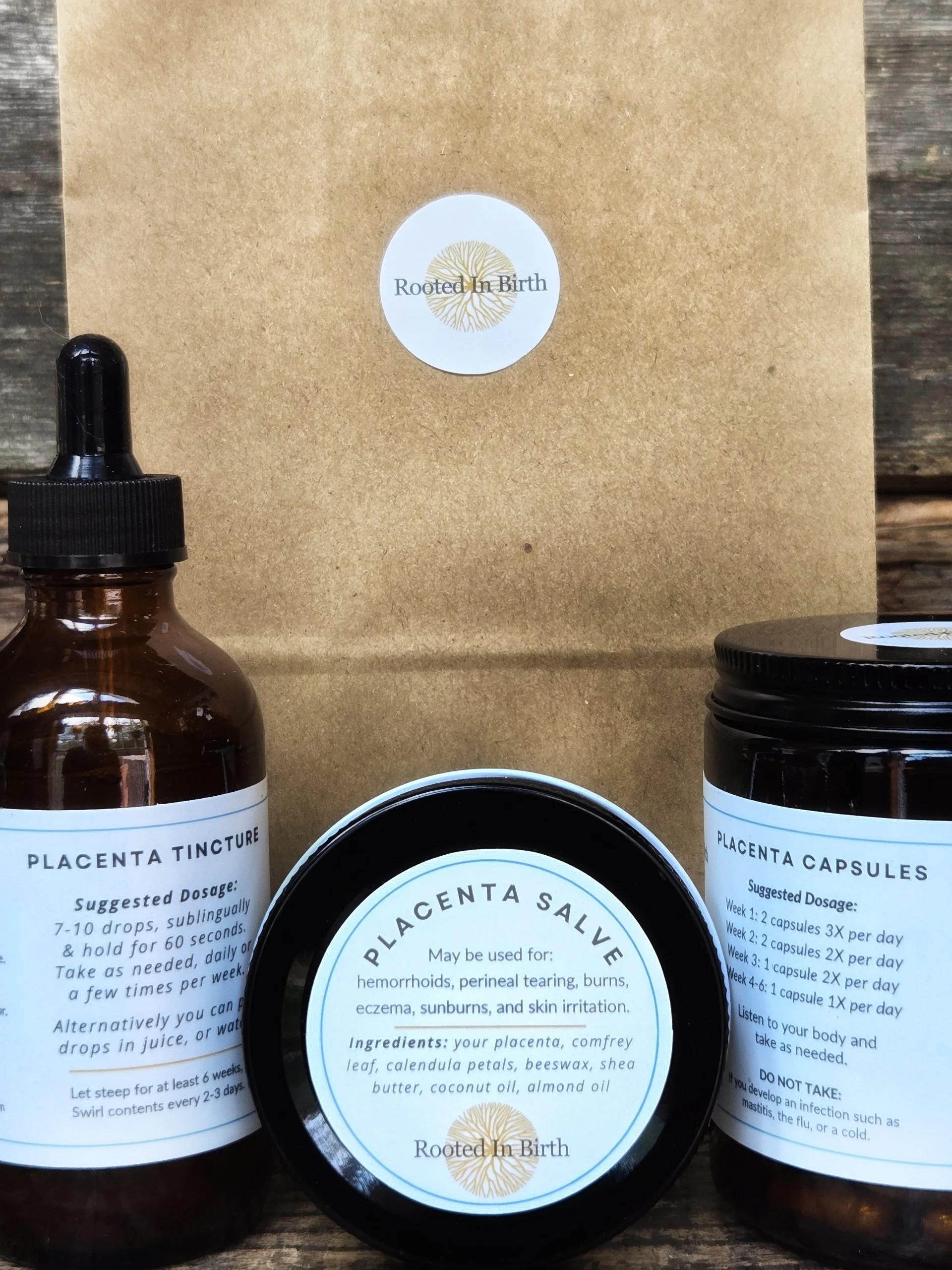
The placenta encapsulation package includes:
a virtual prenatal chat
pick-up* of your placenta
processing and encapsulation of your placenta
delivery of your capsules to your location*
an umbilical Cord Keepsake (provided when possible and if desired)
a postpartum follow-up text/call
Placenta Encapsulation Services $300*
Add-ons:
Placenta Tincture $25
A placenta tincture is a concentrated alcohol solution that contains the powerful nutrients and hormones of your placenta to provide balance when your body needs it. A tinture is great to have once your capsules are gone.
Placenta Salve $40
Wonderful for those who have had Cesarean births. This skin salve can be used to speed up recovery, minimize scarring, itching, and discomfort. It can also be used for hemorrhoids, burns, diaper rash, eczema, sunburns, and minor skin irritations.
Did you know that doula clients receive discounts on childbirth education and placenta encapsulation?
"Jessica was amazing. We had a Zoom meeting prior to her taking my placenta for encapsulation. She answered all of my questions and went over the entire process. My son was born 3 weeks early, and she was still able to accommodate and quickly came to the hospital to get my placenta. The encapsulation process was very quick and came in a professional jar with easy-to-follow directions. She even continued to check in after delivering the capsules. I would highly recommend working with her; she’s great!"
Former ClientFAQs
-
Placenta Encapsulation is the process by which your placenta is processed into capsules you can consume like a daily multi-vitamin. Jessica, from Rooted In Birth, is a Postpartum Placenta Specialist who follows the method of cleaning, steaming, and then dehydrating your placenta prior to grinding it into a powder and placing it in capsules.
The process takes about two hours, two days in a row, to process your placenta. The most time-consuming part of the process is thoroughly cleaning and sanitizing the workspace. On the first day, the placenta is cleaned, drained, steamed, and placed in thin strips into the professional-grade food dehydrator. Your placenta remains in the dehydrator overnight. The next day, each piece of your placenta is tested to ensure it is dehydrated completely before grinding it into a powder and placing it in capsules. Once your capsules are made, they will be placed into a bottle with instructions and dropped off at your door. Your Placenta Specialist will remain available to you for any questions you have during your postpartum period. -
Many people believe that they can improve their postpartum recovery by consuming their placenta. Capsules make for an easy way to do this. The benefits parents seek from consuming their placenta include increased energy and milk supply, nutrient and hormone replenishment, and reduced risk of postpartum depression.
Some of the things your placenta capsules may help with:Preventing and lessening the risk of postpartum depression or ‘baby blues’
Replenishing your iron from blood loss during birth and to prevent postpartum anemia
Lending you a consistent flow of oxytocin long after your birth euphoria ends
Providing the HPL hormone to help establish early and healthy milk supply
To stabilize your ever-changing hormones post-birth
To replenish your B vitamins and energy that were used during the labor and birthing process
Protection from infection and bleeding due to retained placenta tissue or membranes
Offer natural pain relief from the labor and birth of the baby
-
There are many potential benefits of placenta encapsulation, but it is not without risk. The main risks are your potential exposure to bloodborne pathogens (from your encapsulator or other clients) and exposure to bacteria from an improperly handled placenta. Rooted In Birth follows the industry's highest standards for safety to mitigate every possible risk. Our placenta encapsulator holds a bloodborne pathogen certification, a Safe Food Handlers Certification, and has completed extensive hands-on training from leaders in the field.
-
Many people can have their placenta encapsulated, but some can't. If you developed an infection (chorioamnionitis) during your birth, you will not be able to consume your placenta.
There may be other rare complications that might prompt your medical care provider to want to keep your placenta for examination. If your placenta is sent to pathology or has chemicals applied to it, it cannot be encapsulated for your consumption.
GBS or Group B Strep is a common bacterium that does not normally pose a health risk to the birthing person. All bacteria in the placenta is killed during the steaming process. Rarely, GBS can lead to a uterine infection. If you develop a uterine infection or fever during your labor, your placenta would not be beneficial to you postpartum and will likely be taken to pathology. Otherwise, GBS is not contraindicated for placenta encapsulation.
Additionally, if your placenta wasn't stored properly, it will not be able to be encapsulated for you. Your placenta must be placed on ice or in a refrigerator within four hours of its birth and must remain refrigerated. If the encapsulation doesn't begin within 72 hours, the placenta must be frozen. We can encapsulate placentas that have been properly refrigerated and/or frozen within 6 months. Beyond that, the placenta is not considered safe for consumption according to our training standards. All of these details are explained to all clients, and you'll have clear, written instructions. If you hire Rooted In Birth for your placenta encapsulation and you aren't able to keep your placenta, any fees paid less $50 will be refunded to you.
-
The number of pills you can expect depends on a few things: how large your individual placenta is and how long the placenta is steamed for prior to dehydrating. Also, how fine or coarse the dehydrated placenta is ground. Most clients can expect anywhere from 100-175 capsules from their placenta. Your Postpartum Placenta Specialists will go over consumption guidelines with you as we complete your placenta encapsulation.
Store your capsules in a cool, dry place, but not the refrigerator, for up to 6 months. After 6 weeks, if you notice that there are still capsules left, you can transfer them to the freezer for long-term preservation. The capsules will need to come out of the bottle and go into a Ziploc bag.
On average, placenta capsules have a 2-year shelf life. If stored properly, you need not worry about them becoming rancid. After 2 years, their nutritional and hormonal quality greatly decreases. If your capsules are left at 1-2 years postpartum, your best option is to turn the powder into a tincture to stop any further degradation in quality. -
Meconium, or baby's first "poo" is sterile and does not contain fecal bacteria that normal adult stool does and is perfectly fine to encapsulate. Meconium is only dangerous for baby to inhale, but is otherwise harmless. Your placenta is washed thoroughly during the processing of your placenta.
-
You can still encapsulate your placenta(s)! For twin births, there are three different types of twin placentas:
Dichorionic Diamniotic (DiDi twins): This is where there are two placentas, two amniotic sacs, and two babies. These placentas will be processed and packaged separately as the birthing person can react differently to the two sets of hormones.
Monochorionic Diamniotic (MoDi twins): Single placenta, two amniotic sacs, and two babies.
Monochorionic Monoamniotic (MoMo Twins): Single placenta, one amniotic sac and two babies.
Encapsulating twin placentas is slightly different, as their may be one larger placenta, or two placentas to work with during the encapsulation process. For clients with MoDi and MoMom twins, you can expect a large return on capsules as these placentas are normally larger. The encapsulation process is the same as with one placenta. Rooted In Birth does not charge extra for twin placenta encapsulation.
-
Rooted In Birth provides placenta services within a 40 mile radius of 04274. If you are outside of that radius there will be an additional charge based on mileage. Please reach out or see Rooted In Birth's radius map for more information.
-
Everybody's Got One, Radiolab Podcast (Aug 2021)
Placenta – Worth Trying? Human Maternal Placentophagy: Possible Benefit and Potential Risks Jena University: Johnson SK, Groten T, Pastuschek J, Rödel J, Markert UR (Sep 2018)
Maternal Placenta Consumption causes no harm to newborns: ScienceDaily May 2018
Human placentophagy: Effects of dehydration and steaming on hormones, metals and bacteria in placental tissue. Jena University: Johnson SK, Groten T, Pastuschek J, Rödel J, Sammer U, Markert UR (May 2018). Elsevier Sciencedirect.
Does eating placenta offer postpartum benefits? The British Journal of Midwives July 2012; Written by Michelle Beacock – Student Midwife, Edge Hill University, Ormskirk, Lancashire and NCT Antenatal Teacher.